
Time to read:
It’s middle of the workday, you step out to take a quick breather and gaze up the sky. Does it ever make you wonder why no two clouds look ever quite the same? Some look feathery, some blobby and some like white candy floss; some even take shape of your imagination! These floating masses are not just beautiful, but hold great atmospheric significance as well.
What are clouds?
Clouds are accumulated masses of water droplets or ice crystals suspended in the earth’s atmosphere. A cloud forms through the following sequential process:
- The evaporated water from the surface of the earth reaches the atmosphere.
- Once a patch of atmosphere has enough vapour, the area becomes saturated with water vapour.
- A right drop in temperature in the atmospheric patch initiates the condensation of vapour to liquid thus creating a cloud.
Have you ever tried to predict whether rain is coming just by looking at the clouds? White clouds suggest a fair weather while grey clouds mean rain is right around the corner. Clouds look white or grey based on how they reflect light, and this gives us a decent indication of the day’s weather. When water droplets inside the cloud are packed densely, they reflect most of the sunlight, making them appear white. When the water droplets begin to turn into raindrops, they become loosely packed, absorbing most of the sunlight, thus, making them appear grey or black.
What are the types of clouds?
Now comes the most fascinating part—cloud classification. By the end of this reading, you are sure to leave as a true cloud aficionado! Clouds are classified based on their: A.Shape, B.Altitude ,and C.Rain bearing capacity. There are primarily three shapes of clouds—cirrus, cumulus and stratus.
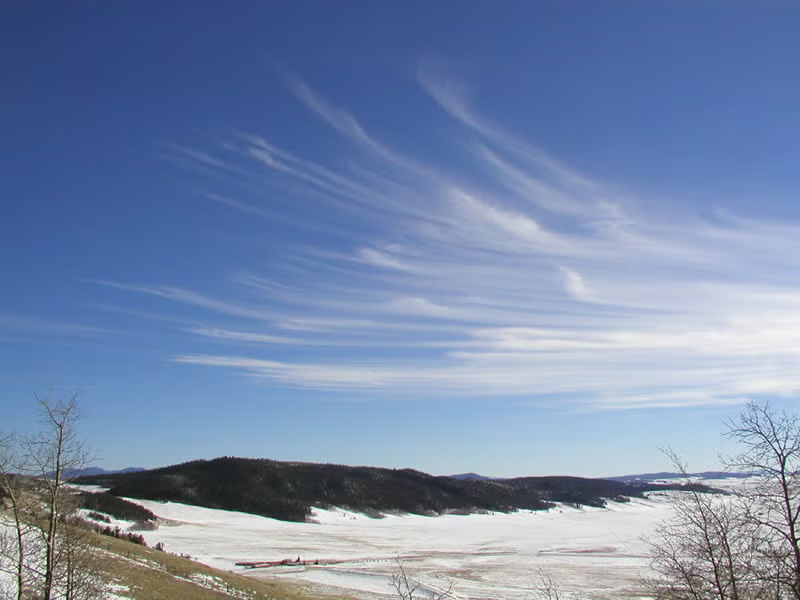
Cirrus clouds are thin, curly and feathery. As they are present above 6000 metres from the earth’s surface, where temperature is quite low, cirrus clouds are made up of ice crystals. They typically indicate a clear weather.
Cumulus clouds are lumpy, fluffy and cotton-like. They can be present at different heights from the earth’s surface. The altitude at which the base of a cumulus cloud is situated determines the weather. Higher is the base, clearer is the weather whereas, lower cumulus cloud base usually brings heavy rain or snowfall.
Stratus clouds are like horizontal sheets and can be found at various heights. Low-hanging stratus clouds form a grey blanket over the ground, and indicate an overcast day resulting in drizzle or light snow.

The prefix “cirro-” denotes clouds positioned above 6000 meters. The prefix “alto-” refers to clouds positioned between 2000m and 6000 meters. The prefix “nimbo-” or the suffix “-nimbus” indicate clouds with high rain-bearing capacity. The figure below illustrates variations of clouds based on these factors.
How to name a cloud?
Now that you know the cloud types, use these steps to identify one the next time you look up.

Let’s explore an example. You scan the sky and spot a cloud in the mid layer of the atmosphere. You see a sheet-like cloud denoting it is a stratus cloud. It appears grey indicating a heavy precipitation, thus, suggesting the use of prefix “nimbo-”. The cloud you spotted is a nimbostratus cloud!
Cloud change shape over time. For instance, after the precipitation ends, cumulonimbus clouds turn into stratocumulus clouds. So, your analysis of the cloud is time-specific. Checkout these real-time images of some clouds.


Cloudy and moody?
Have you ever looked up at an overcast sky and felt your mood instantly drop? Well, sunlight and weather shape our mental health in more ways than we can imagine. Our circadian rhythms are governed by light as it helps in secretion of melatonin, the sleep-inducing hormone . While specific weather can trigger profound conditions like Seasonal Affective Disorder for some, others pass through the changing skies entirely unfazed. For some a gloomy weather can dampen the mood, but for some the smell of rain (petrichor) may be quite enriching and up-lifting. Nevertheless, clouds are one of nature’s many wonders, and quoting from Percy Bysshe Shelley’s 1820 poem, The Cloud:
“I am the daughter of Earth and Water,
And the nursling of the Sky;
I pass through the pores of the ocean and shores;
I change, but I cannot die.”
Did you know?
- For meteorological studies, cloud cover is measured using the unit ‘okta’. An okta represents how many eighths of the sky(octo-) is covered in clouds. A completely clear sky measures zero oktas, while a fully overcast sky reaches eight oktas.
- A contrail is straight line cloud left by a jet flying at a high altitude in the sky. When hot exhaust from the jet gets instantly condensed due to the low temperature of the atmosphere, it leaves the trails.
Check out the crochet piece of a cumulus cloud I made, here.
References:
https://education.nationalgeographic.org/resource/cloud
https://whatsthiscloud.com/cloud-identification
https://scied.ucar.edu/image/cirrus-clouds
https://wmo.int/world-meteorological-day-2017/classifying-clouds
https://watersidebehavioralhealth.com/blog/how-does-overcast-affect-mental-health
https://www.poetryfoundation.org/poems/45117/the-cloud-56d2247bf4112
Leave a Reply